Intrinsic Core and the Open Machine Tending Solution

· 20 min read

Intrinsic Core brings together robotics capabilities and a structured way to build industrial robot applications. It is now open source under the Apache 2.0 licence, and comes with a reference project, the Open Machine Tending Solution (OMTS), that shows how to use it.

In this post, I'll show what Core provides and dig into the OMTS to see how its pieces fit together into a working application. I'll also share the trade-offs I encountered, consider when I'd choose it over assembling a solution with ROS 2, and show how you can get involved in the developer community.
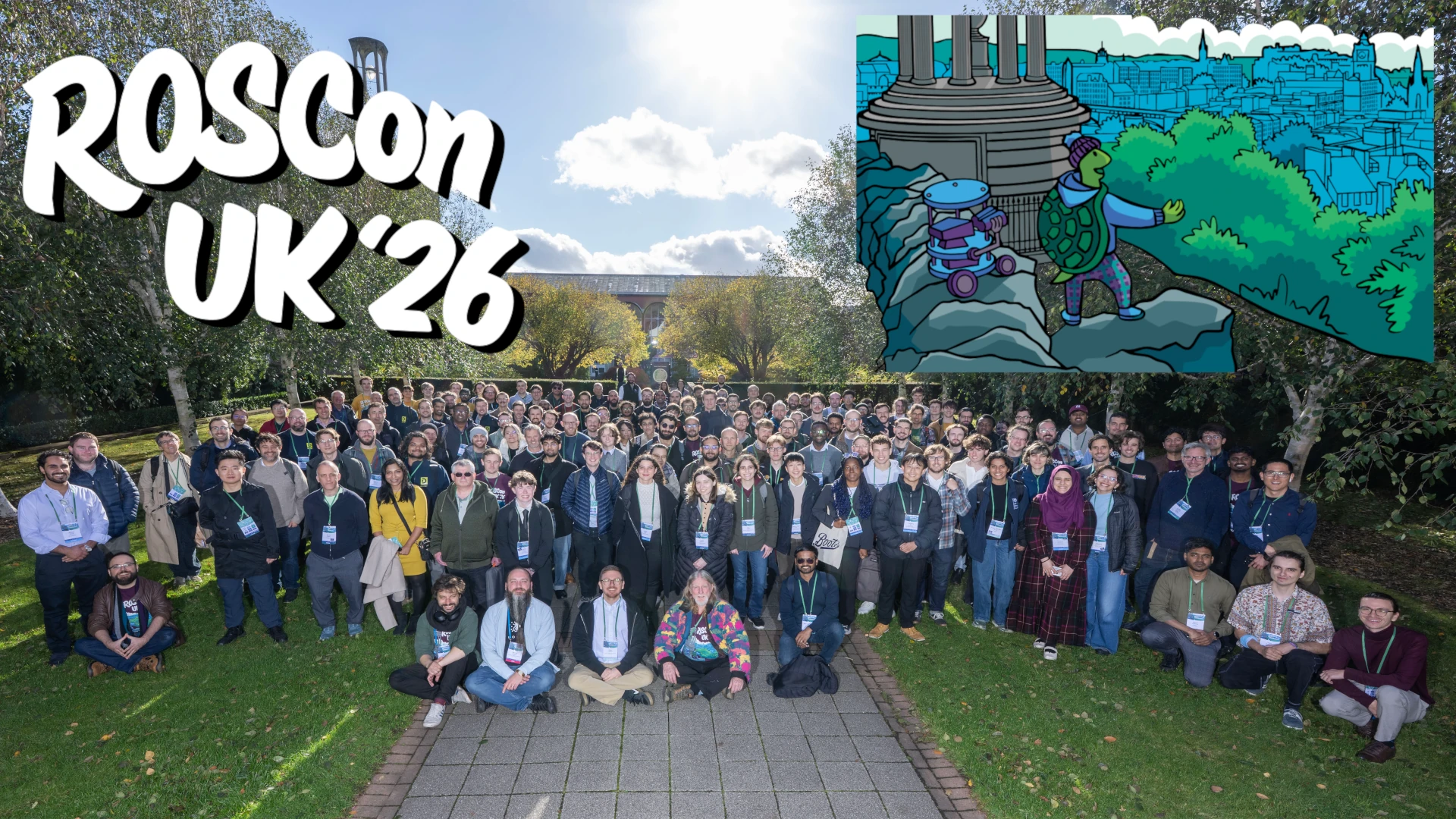
ROSCon UK 2026

· 12 min read

In October, I attended the ROSCon UK 2026 conference in Edinburgh to give a talk about my rover. The talks and workshops were valuable, but the most useful parts were the conversations and community: from the author of the localisation package checking my rover configuration to finding people interested in a Cambridge robotics hackathon.

FOSDEM Robotics Dev Room Summary

· 12 min read

FOSDEM is a conference which is free to attend. This year's conference (2026) was held in Brussels, Belgium over two days. The talks were separated into tracks based on subject, and one of the tracks was Robotics & Simulation. I managed to see almost all of the talks, but the room was constantly full with a long queue - clearly, robotics is popular!

This post is a summary of the talks with links and my own thoughts. If you'd rather go direct to the source, go to the FOSDEM 2026 website (specifically, the Robotics & Simulation track page).

Deploying Ultralytics YOLO26 Using ROS 2

· 25 min read

Computer Vision (CV) is when a machine processes visual data to perceive its environment, just as humans can. Robots using CV can operate on single images or continuous video data, which allows them to recognise objects, detect obstacles, track movements over time, and navigate in complex space. For instance, autonomous vehicles can use camera data for safety systems or even fully autonomous driving.

This post walks through building a simple ROS 2 node that detects objects in real time using a robot's webcam and the Ultralytics YOLO26 model. The purpose is to show how simple it is to deploy Ultralytics models on a robot using the ultralytics Python package, as well as walking through a simple ROS 2 node for CV.

Comparing Rust Libraries for ROS Nodes

· 22 min read

While looking for guest speakers for the Cloud Robotics Working Group, I came across roslibrust, which is a package for building nodes in Rust that can communicate with ROS. Given how different the approach is from ros2rust, I decided to make a few simple nodes in both libraries to see how they compare. This post compares the two libraries by writing the same application in each.

This post is also available in video form. If you'd prefer to watch, click the link below: